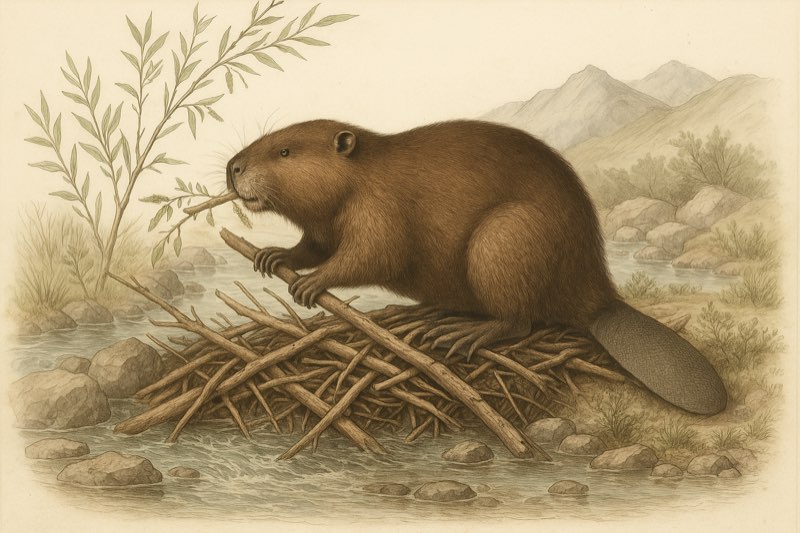
Somewhere in Northern California, a team of restoration workers stands knee-deep in a degraded stream. No excavators. No concrete. No six-figure engineering contracts. Just wooden posts, willow branches, and a very old idea: build like a beaver.
The technique is called Low-Tech Process-Based Restoration, or LTPBR. It's exactly what it sounds like — restoration done by hand, using simple materials, designed to mimic natural processes that keep ecosystems healthy. And the centerpiece of the movement is the beaver dam analog (BDA): wooden posts sunk into a streambed with willows woven between them, creating a structure that does what beaver dams have done for millions of years.
Slow the water. Spread it across the floodplain. Let it sink into the ground.
What Went Wrong
Before European settlement, North America was home to an estimated 60 to 400 million beavers. Their dams created vast networks of wetlands — slow, meandering, connected systems of pools and channels that stored water, filtered sediment, recharged aquifers, and supported extraordinary biodiversity.
Then came the fur trade. By the early 1900s, beavers had been trapped to near-extinction across most of the continent. Without their dams, streams began to incise — cutting deeper and narrower into the landscape. Water that once spread slowly across floodplains now rushed through single channels, eroding banks, draining wetlands, and carrying sediment downstream into reservoirs.
The result is what restoration ecologists call a "degraded" stream: a deep, narrow trench where a wide, wet meadow used to be. Less water reaches plant roots. Less water recharges the water table. Fish lose the deep, cool pools they need to survive summer. And when wildfire comes — as it increasingly does — there's no green, wet buffer to slow its advance.
The Simplest Fix in Restoration Science
The LTPBR approach doesn't try to engineer a river into a predetermined shape. Instead, it asks a different question: what natural process is missing, and how do we kickstart it?
The answer, overwhelmingly, is beaver activity.
A beaver dam analog is almost absurdly simple. A crew drives wooden posts into the streambed, then weaves willow branches between them. The structure doesn't need to be perfect — it just needs to slow water down enough to force it up and over the banks. Nature handles the rest.
Within months, the backed-up water begins spreading across the floodplain. Sediment settles behind the structures, raising the streambed. Willows and other riparian plants take root in the newly wet soil. The stream begins to braid — splitting into multiple channels that slow the flow even further. And in many cases, the ultimate validation arrives: actual beavers move back in and start building their own dams.
The Numbers
The science behind LTPBR is growing rapidly. A comprehensive 2024 report from American Rivers reviewed dozens of peer-reviewed studies and found consistent results:
- Groundwater recharge: Beaver dams and their analogs trap fine sediment and increase soil moisture across floodplains, effectively turning degraded streams back into sponges that store water underground.
- Biodiversity: Beaver wetlands are considered among the most biodiverse habitats in North America. The slow, connected water creates shelter for juvenile fish, nesting sites for waterfowl, and habitat for amphibians, insects, and dozens of plant species.
- Wildfire resistance: The green corridors created by beaver wetlands stay wet and vegetated deep into fire season. Research has documented beaver wetlands acting as natural firebreaks — green refugia that survive when surrounding landscapes burn.
- Water temperature: Deep pools behind beaver dams provide cold-water refugia critical for salmon and trout survival during increasingly hot summers.
- Climate resilience: The Beaver Institute summarizes substantial evidence that beaver-related restoration increases climate resilience by reducing summer water temperatures, increasing summer flows, and enhancing floodplain habitat.
A Case Study: Yellow Creek, California
On Maidu ancestral land in Northern California, Swift Water Design — a restoration firm founded by Kevin Swift — has been working since 2019 on a project that perfectly illustrates the LTPBR philosophy.
They started small: four structures built in a single day to address a headcut — a point where the stream was actively eroding deeper into the landscape. Then a few more BDAs upstream. Total investment to that point: minimal.
By 2021, after the Dixie Fire swept through the region, they expanded to roughly 30 structures and connected an adjacent tributary. At $40,000 into the project, they had built about a mile of new stream that activated two more miles of floodplain downstream.
In early 2022, they added 70 more structures over five days. The system's response was dramatic — channels braiding, water spreading, vegetation exploding. That fall, they held the first "Build Like a Beaver" workshop, training others in the technique.
Then came the real milestone. In 2023, the California Department of Fish and Wildlife released seven beavers into the restored area. The beavers — the original engineers — took over where the human crews left off.
By 2025, the Maidu Summit Consortium was learning to maintain the structures themselves, and the beavers were, in Kevin Swift's words, "rioting" — building, expanding, doing what beavers do. The project was handed back to the land's original stewards and its original engineers simultaneously.
Why This Matters Beyond the West
LTPBR was developed primarily in the arid and semi-arid West, where water scarcity makes every drop count. But the principles apply everywhere streams have been degraded — and that's most of America.
In the Southeast, where EPR Foundation operates, thousands of miles of streams have been channelized for agriculture, straightened for development, or degraded by decades of stormwater runoff. The same incision, the same loss of floodplain connectivity, the same disappearance of the wet, slow, complex stream systems that once defined healthy watersheds.
Beaver populations in the Southeast are recovering from their historic lows, but they need connected habitat to thrive. And the LTPBR toolkit — BDAs, post-assisted log structures, even simple rock placements — translates directly to Southern streams.
The Economics of Simplicity
Traditional stream restoration is expensive. Engineered channel redesigns can cost hundreds of thousands to millions of dollars per mile, requiring heavy equipment, detailed engineering plans, and years of permitting.
LTPBR projects, by contrast, are built by hand. The materials — wooden posts and willow branches — are often sourced on-site. A trained crew can install dozens of structures in a single day. And because the approach works with natural processes rather than trying to override them, the river does most of the heavy lifting after installation.
The Yellow Creek project demonstrates this beautifully: years of progressive, low-cost interventions that let nature amplify each investment. You don't have to get it perfect on day one. You just have to get the process started.
Slow It, Spread It, Sink It
That's the mantra of the LTPBR community, and it captures everything you need to know about how healthy waterways work. Water needs to be slowed down so it can spread across floodplains and sink into the ground — recharging aquifers, growing vegetation, creating habitat, and building resilience against drought and fire.
Beavers figured this out millions of years ago. We just forgot. The people building beaver dam analogs by hand — armed with nothing more than posts, willows, and a deep understanding of how rivers work — are helping us remember.
The craft of dam building isn't new technology. It's the oldest technology. And it might be the most important restoration tool we have.