Kevin Swift doesn't use the word maintenance. It's not in his vocabulary, and he doesn't want it in yours.
"If a project requires continual, perpetual maintenance, then it failed at the design phase," Swift says. "Having to work forever just to get to zero is no way to fix our landscapes."
Swift is the founder of Swift Water Design, a restoration firm based in California that has quietly become one of the most prolific practitioners of process-based restoration in the world. Their tagline — "We Make Dry Land Wet" — is both a promise and a philosophy. And the way they keep that promise is by thinking like the animal that's been doing this work for millions of years.
The Beaver's Blueprint
The idea behind Swift Water Design's work is deceptively simple. Across the American West — and increasingly, across the world — streams have been degraded by centuries of abuse: beaver trapping, wetland draining, overgrazing, channelization, and fire suppression. The result is what hydrologists call "incised" streams — deep, narrow trenches that rush water through the landscape before it can soak in, support vegetation, or sustain life.
The fix? Build structures that do what beaver dams do naturally. Slow the water. Force it up and over the banks. Let it spread across the floodplain. And then step back and let the river take over.
"Think of it like a conversation with a riverscape," Swift explains on his company's website. "We say 'Hello' by opening up freedom space for the river, and building the initial structures. The river responds with 'Yes, no, a little more over there, maybe add a tree here, and how about some fire,' and we respond again. As the landscape starts to become autonomously regenerative, we adjust and ultimately reduce our inputs to zero."
Tásmam Koyóm: Where It All Came Together
The story of Swift Water Design's most transformative project begins with an act of return.
In 2019, the Maidu Summit Consortium — a nonprofit composed of nine Mountain Maidu tribal member groups — received 2,300 acres of ancestral land in California's Humbug Valley, known to the Maidu as Tásmam Koyóm. The land had been held by PG&E and was returned to the tribe as part of PG&E's land divestiture. According to Swift Water Design, it was the site of the first legal beaver reintroduction in California in 75 years.
The valley's streams were deeply incised — cut down into narrow channels that had disconnected from the surrounding meadow. Previous restoration had used heavy equipment for "pond and plug" work, but the Maidu wanted something different. "We wanted to try to restore habitat more naturally in a less invasive way," said Trina Cunningham, executive director of the Consortium.
Swift Water Design started with a one-day pilot. Four structures to address a headcut. A couple of small beaver dam analogs upstream. Total investment: almost nothing.
Then they kept coming back.
In 2020, they reworked the original structures and added a few more. In 2021, after the Dixie Fire swept through the region, they built around 30 structures and connected an adjacent tributary. At $40,000 into the project, they had built about a mile of stream that activated two more miles of floodplain.
In early 2022, they spent five days installing 70 more structures. "It was just incredible how well the system responded once it was really fattened up," Swift wrote. That fall, they held the first "Build Like a Beaver" workshop and began work on a side channel to Yellow Creek.
In 2023, the California Department of Fish and Wildlife released seven beavers into the restored area. The original engineers were back.
By 2025, Swift Water Design was training the Maidu Summit Consortium to maintain the structures themselves. The beavers were, in Swift's words, "rioting." The project had been handed back — simultaneously to the land's original stewards and its original engineers.
How You Build Like a Beaver
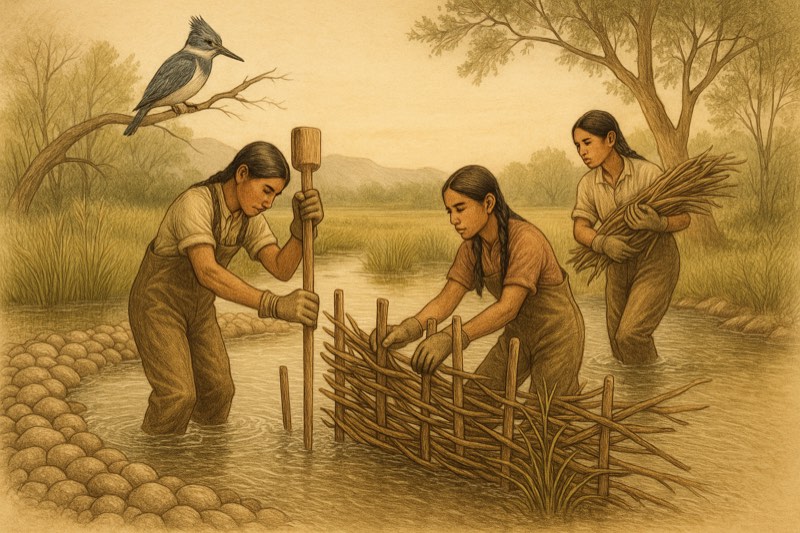
The construction technique is startlingly low-tech. As Swift describes it: "You build low with a heavy, wide base, a low rise on the front and back, just like a beaver dam, and you just sort of needlefelt together all of the materials you find around, making a kind of lasagna."
A crew drives wooden posts into a streambed, then weaves branches — often willow, sometimes pine — between them, packing the gaps with mud. The finished structure looks like "a big messy pile of mud and sticks like a beaver dam holding water." At base flow, water should be going over the top.
If willow grows nearby, Swift adds living cuttings to the structure as he builds it. "Those willows will root and sprout and help perennialize the structure." The dam becomes a living thing — growing, adapting, getting stronger over time.
Sophia Williams, a young Mountain Maidu tribal member who participated in the Yellow Creek project, described the experience: "Once all the willow was woven we then filled in all the gaps with more willow and packed it with mud. Just after an hour of the analogs being built, the stream began to rise."
One hour. That's how fast a hand-built beaver dam starts changing a landscape.
The Philosophy of Phased Work
What makes Swift Water Design's approach distinctive isn't just the technique — it's the patience. They don't try to fix everything at once. They don't bring in heavy equipment. They don't impose a form on the river.
Instead, they return to sites year after year, adjusting, adding, responding to what the river tells them. Each round of work is designed to be "easier, faster, cheaper, and lighter touch" than the last. The river does more work each year. The humans do less.
This is the opposite of how most environmental restoration works. Traditional stream restoration involves detailed engineering plans, heavy equipment, imported materials, and a single massive intervention designed to create a predetermined channel shape. It costs hundreds of thousands to millions of dollars per mile. And it often fails, because rivers don't like being told what shape to be.
Process-based restoration costs a fraction of that. The Yellow Creek project — six years of progressive work across multiple phases — has achieved landscape-scale transformation for less than the cost of a single traditional restoration project. And it's still getting better every year, because the river is doing the work now.
Going Global
In April 2024, Swift and his collaborator Kate Lundquist of the WATER Institute traveled to France to conduct trainings on beaver and process-based restoration in three watersheds across the country. French artist Suzanne Husky and philosopher Baptiste Morizot helped organize the events, which brought together 40 restoration professionals, agency staff, and regulators.
At the first site near Bordeaux, the team installed two dozen structures on Ruisseau de Taleyson Creek in the Ciron watershed in a single day. The results were immediate — wider wetted area, increased channel complexity, expanded aquatic habitat. At the Véore and Lierne River sites in eastern France, one participant reported that "secondary channels have been reopened, the water levels have risen, new wetlands have appeared, sediments have accumulated, a quantity of habitats for fish fauna have been created."
Swift Water Design has now trained over 400 people in process-based restoration, both domestically and internationally. Their annual "Build Like a Beaver" training, held through the California Process Based Restoration Network, has become a pilgrimage for people who want to learn the craft.
The Culture of the Crew
There's something unusual about how Swift Water Design talks about their work. They don't talk about it like engineers. They talk about it like a way of life.
From their company values: "A crew has to be a mutually self-supporting organism to survive. We share food, water, sunscreen, tools, stories, encouragement, jokes, tasks, good and bad times. Be the first to pick up a tool, and the last to set them down. Race the others to get first dibs on the worst, hardest, most boring job. Leave the last beer in the cooler."
This isn't corporate culture. It's field culture — born from weeks at a time living outside, sleeping on the ground, doing physical work in remote places with no TV and no creature comforts. It produces a kind of person and a kind of team that most organizations can only dream about.
"Nobody's good at something the first time they try it, and that's OK," the company writes. "The important thing is that we keep improving our skills as we go, and yes, it's still possible to get better at using a shovel after five years."
What This Means for the Rest of America
Process-based restoration was developed in the arid West, where every drop of water matters. But degraded streams aren't a Western problem. They're an everywhere problem.
In the Southeast, thousands of miles of streams have been channelized, straightened, or degraded by stormwater runoff and development. The same disconnection between water and land that plagues Western landscapes exists in Georgia, Alabama, the Carolinas, and across the region. Beaver populations are recovering but need connected habitat to thrive.
The tools translate directly. Beaver dam analogs, post-assisted log structures, simple rock placements — all of these can be built by hand in Southern streams. The materials are local. The labor is available. The science is proven.
What's needed is awareness — and people willing to pick up a shovel.
A Conversation Worth Having
Kevin Swift and the crews at Swift Water Design have built over 3,100 structures on more than 50 miles of streams over six years. They've helped reintroduce beavers to ancestral lands. They've trained hundreds of people on two continents. They've proven that the most powerful restoration technology isn't a machine — it's a pattern that nature perfected millions of years ago.
"If the stream doesn't like something, you'll get quite a critique," Swift says.
The streams are talking. The question is whether we're ready to listen.