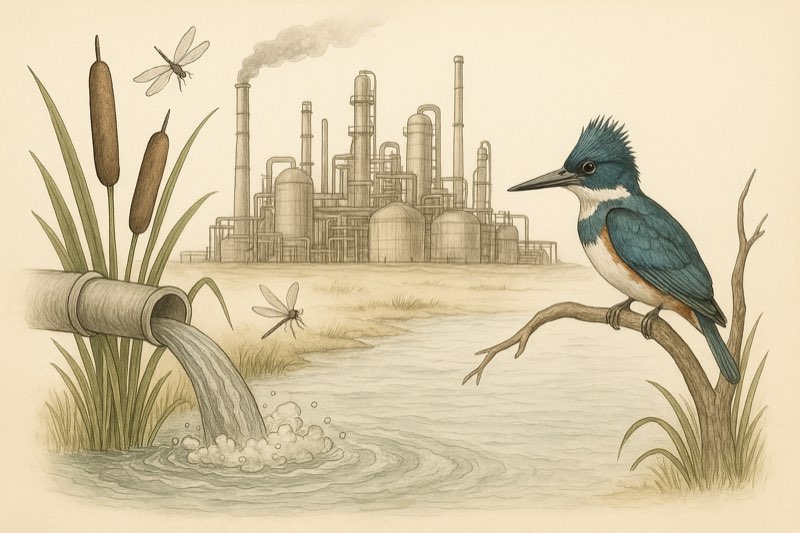
In early 2021, residents of St. Croix in the U.S. Virgin Islands woke up to an oily mist settling on their homes, their cars, their children's schools. The Limetree Bay refinery — a massive industrial complex that had been allowed to restart after years of dormancy — was releasing noxious emissions and petroleum into the air, contaminating drinking water cisterns that thousands of families depended on. Schools closed. People got sick. EPA eventually invoked its emergency authority under the Clean Air Act to shut the facility down, but the question lingered: Why did it take an emergency to get anyone to act?
The answer, as with so many environmental failures, comes down to capacity. Not the capacity of the law — the Clean Air Act is clear. Not the capacity of the science — the health risks of refinery emissions are well-documented. The capacity of the people and institutions charged with enforcing the rules. And that capacity is eroding at a pace that should alarm every American who drinks water, breathes air, or lives within fifty miles of an industrial facility.
The Numbers Tell a Story
EPA's enforcement and compliance assurance budget — the money that pays for inspectors, investigators, and the attorneys who bring polluters to account — stood at roughly $370 million in fiscal year 2025. That covers civil enforcement ($201.3 million), criminal enforcement ($60 million), and compliance monitoring ($107.1 million). Those numbers sound substantial until you consider that EPA oversees compliance with the Clean Air Act, the Clean Water Act, the Resource Conservation and Recovery Act, the Safe Drinking Water Act, and dozens of other statutes across hundreds of thousands of regulated facilities nationwide.
The FY 2026 President's Budget proposed cutting those numbers dramatically: a 30% cut to civil enforcement, a 49% cut to criminal enforcement, and a 35% cut to compliance monitoring. Environmental justice enforcement funding would be eliminated entirely. The Environmental Protection Network — a nonpartisan organization of former EPA career staff — called it a "deliberate dismantling" of the agency's enforcement infrastructure.
If enacted, the cuts would bring EPA's total budget to $4.16 billion, down from $9.14 billion — a 54% reduction. The workforce would shrink to 12,856 full-time employees, the lowest level in roughly 40 years. For context, EPA employed between 16,000 and 18,000 people through the 1990s and 2000s, a period when the regulated universe was smaller than it is today.
What Enforcement Decline Looks Like on the Ground
Numbers on a budget spreadsheet don't convey what happens in real communities. Here's what the data shows:
As of early 2026, the Environmental Integrity Project documented nearly 700 industrial facilities on EPA's own list with "high priority violations" of air pollution laws that had persisted for nearly three years. Of those, only 12% had received any enforcement action in the preceding year. Over 3,000 facilities were in "significant noncompliance" with the Clean Water Act for at least three years, and just 2% had faced any enforcement action. The Environmental Integrity Project's assessment was blunt: "EPA and the Department of Justice have all but abandoned pursuing complex, high-impact cases involving serious violations that threaten public health and the environment."
In the most recent year measured, the federal government brought only 16 lawsuits against polluters for environmental violations — compared to 67 in 2021 and 86 in 2017. Meanwhile, a shift toward smaller, paperwork-oriented administrative cases — about 40% of which involved just two narrow categories (industrial risk management plans and drinking water system standards) — creates the appearance of activity while serious violations continue unchecked.
The Environmental Data and Governance Initiative (EDGI) has tracked enforcement trends over decades and found that by FY 2022, enforcement funding was 29% below its FY 2011 peak in real dollars and 14% below FY 2016 levels. Criminal cases opened and compliance costs imposed on violators remained "among the lowest in decades." Civil fines were at just 88% of the 30-year median. Inspections — the front-line activity that catches violations before they become crises — were similarly depressed.
The State Funding Cliff
Here's where the enforcement gap becomes a chasm. States conduct the vast majority of day-to-day environmental enforcement in America. Under our federal system, EPA delegates implementation of the Clean Water Act, the Clean Air Act, RCRA, and the Safe Drinking Water Act to state agencies, which then run the inspection programs, issue permits, and pursue violations. But many of those state programs depend heavily on federal grants to function.
The FY 2026 budget proposal eliminates nearly all categorical grants to states — roughly $1 billion in funding that state agencies use to staff their environmental programs. The cuts include:
- $235.6 million for State and Local Air Quality Management — eliminated
- $225.4 million for Clean Water Act Section 106 pollution control — eliminated
- $174.3 million for nonpoint source pollution management — eliminated
- $115.8 million for public water system supervision — eliminated
- $46.2 million for brownfields grants — eliminated
Water infrastructure funding would be cut by approximately 90%. Regional water quality programs — including protections for the Great Lakes, Puget Sound, San Francisco Bay, and Lake Champlain — face cuts exceeding $83 million.
Circle of Blue, which covers global water issues, described the impact directly: when federal support wanes, states often cannot or do not backfill the cuts. The result is fewer inspections of wastewater treatment plants and industrial dischargers, slower detection of nutrient pollution and PFAS contamination, and increased risk of drinking water contamination.
The Great Lakes states offer a cautionary example. Federal funding supports the state staff who monitor and enforce pollution controls across one of the world's most important freshwater ecosystems. Reductions in EPA Great Lakes funding ripple directly into state agency budgets, leading to gaps in oversight that can produce real consequences — like the harmful algal blooms that have periodically rendered Toledo, Ohio's drinking water unsafe.
When Enforcement Fails, Communities Pay
The pattern repeats across the country. In Kalamazoo, Michigan, PCB contamination in the Kalamazoo River and Portage Creek was identified and the site placed on the Superfund National Priorities List in 1990. It took thirty years — until December 2020 — for EPA and the Department of Justice to secure a consent decree worth $245 million from NCR Corporation to fund cleanup and restoration. Thirty years during which communities lived alongside contaminated sediments and floodplains while enforcement staff were stretched too thin to move faster.
EDGI found that Superfund enforcement funding in FY 2022 was 36% below its FY 2011 peak in real terms. That kind of erosion doesn't just slow cleanup — it means sites languish for decades while responsible parties delay and communities suffer.
In North Denver and Commerce City, Colorado, the Suncor Energy oil refinery has a long history of air pollution violations, odor complaints, and flaring events disproportionately affecting the surrounding largely Latino, working-class neighborhoods. A 2024 study in Sociological Forum examined the case as an example of "state-facilitated corporate crime," documenting how limited enforcement resources, small fines, and the practice of allowing companies to offset penalties through supplemental environmental projects effectively recycled penalty money back to the industry. One community advocate quoted in the study put it simply: "You fine an industry, then return the funding to them."
The Citizen Suit Paradox
Legal analysts anticipate one consequence of declining enforcement: an increase in citizen suits. The Clean Air Act, the Clean Water Act, and RCRA all contain provisions allowing private citizens to sue polluters when government agencies fail to act. Holland & Knight, a major law firm, has explicitly noted that reduced EPA enforcement "could result in an increase in citizen suits."
This is a paradox worth sitting with. Environmental laws were designed with enforcement as a public function — taxpayer-funded, professionally staffed, with the investigative tools and institutional knowledge to hold major polluters accountable. Citizen suits were intended as a backstop, not a primary enforcement mechanism. When communities have to hire their own lawyers and fund their own technical experts to enforce the law against industrial polluters, the system has inverted. The burden has shifted from the government to the people the government exists to protect.
What Accountability Looks Like
At EPR Foundation, we don't view enforcement through a partisan lens. Environmental enforcement has declined across multiple administrations and both parties. The erosion of capacity has been gradual — a few hundred fewer FTEs here, a real-dollar budget freeze there — punctuated by sharper proposed cuts that Congress has sometimes but not always moderated.
What we believe is straightforward:
Laws without enforcement are suggestions. The Clean Air Act, the Clean Water Act, RCRA, and the Safe Drinking Water Act are remarkable achievements of American governance. They established the principle that no one — not a multinational corporation, not a municipal government, not a federal agency — has the right to poison someone else's air or water. But those laws only work if someone is watching, measuring, inspecting, and holding violators accountable.
Enforcement protects markets, not just communities. Companies that comply with environmental regulations invest real money in pollution controls, proper waste disposal, and clean operations. When violators face no consequences, compliant companies face unfair competition from those who cut corners. Strong enforcement creates a level playing field.
Transparency is the first step. Every American should be able to easily find out which facilities in their community are in violation, how long those violations have persisted, and what — if anything — enforcement agencies are doing about it. EPA's ECHO (Enforcement and Compliance History Online) database exists, but it's underfunded and difficult for non-experts to navigate. State-level compliance data is often worse.
What You Can Do
Enforcement capacity is a budget question, and budgets are public decisions. You can track EPA's enforcement budget through the appropriations process. You can look up facilities in your area through EPA's ECHO database and see their compliance history. You can attend your county commission or city council meetings when environmental permits are on the agenda — decisions about zoning, landfill siting, and industrial permits are often made with few members of the public present.
And you can support organizations — including EPR Foundation — that track enforcement data, publish permit analyses, and make the invisible machinery of environmental governance visible to the people it's supposed to serve.
The gap between law and enforcement is where pollution lives. Closing it isn't radical — it's the minimum requirement for the laws we already have to do what they were written to do.