In October 2020, Lee Donahue was a few months into her first term as a town supervisor in the Town of Campbell, Wisconsin. She got a call from the town clerk with news that would define the next half-decade of her life: the City of La Crosse had reported that local water might be contaminated with something called PFAS.
"I don't even know what that is," Donahue told the clerk. Neither of them did.
By the time the Wisconsin Department of Natural Resources finished testing, they would both know far more than they ever wanted to.
The Island Between Two Rivers
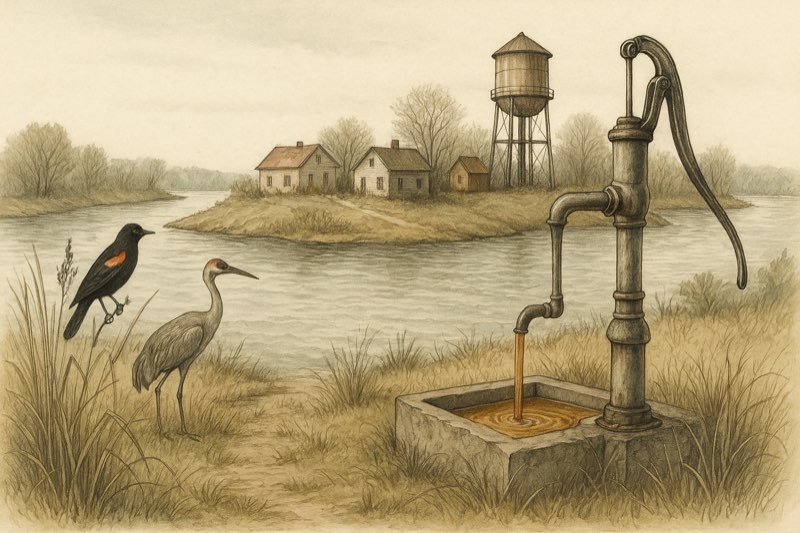
French Island sits in La Crosse County, Wisconsin, a sliver of land between the Mississippi River to the west and the Black River to the east. About 4,300 residents live here in roughly 1,650 households, nearly all of them drawing drinking water from private wells tapped into a shallow aquifer beneath the island.
The island is also home to the La Crosse Regional Airport, owned and operated by the City of La Crosse. For decades, the airport used aqueous film-forming foam — AFFF — for firefighting training exercises, emergency responses, and equipment testing. AFFF is extraordinarily effective at smothering jet fuel fires. It is also loaded with per- and polyfluoroalkyl substances, the synthetic chemicals now known as "forever chemicals" because they do not break down in the environment.
When AFFF was sprayed on the tarmac or in training areas, it didn't disappear. It soaked into the soil. It reached the shallow groundwater. And it migrated — slowly, invisibly — into the aquifer that fed every private well on the island.
"We're Going to Stop Testing. It's Everywhere."
After that first phone call, Donahue pushed the Wisconsin DNR to test broadly — not just the neighborhood immediately downstream of the airport, but the entire island, north, south, east, and west. The DNR tested just shy of 600 wells.
The results were staggering. Of the 538 wells where PFAS was detected, 165 exceeded Wisconsin's recommended groundwater standard of 20 parts per trillion for PFOA and PFOS. Nine wells exceeded 1,000 parts per trillion — more than 50 times the state threshold and 250 times the EPA's current maximum contaminant level of 4 parts per trillion.
Overall, 97.3 percent of all wells tested showed some level of PFAS contamination.
"And the DNR said, 'OK, we're going to stop testing. It's everywhere,'" Donahue recalled in a 2024 interview with Milwaukee Public Radio.
The DNR issued a town-wide water advisory. Residents were told to stop drinking from their wells. The state began supplying bottled water — initially four semi-truck loads of cases distributed at community events, then an ongoing program through Culligan delivering five-gallon containers to homes.
Living on Bottled Water
For the families of French Island, the advisory meant an immediate and disorienting change in daily life. Kitchens filled with cases of bottled water. Families hauled, stored, and recycled hundreds of plastic bottles each month. Parents mixed baby formula with bottled water. Coffee, cooking, even the water for the family dog — all bottled.
Peter Davison, a Campbell resident who grew up on French Island and moved back to start a family, watched his twins grow up without ever drinking tap water. They were born around the time the contamination was discovered. By 2024, they were in kindergarten.
"Now they're kindergarteners. They're thriving," Davison said. But their entire lives — morning sippy cups, school thermoses, dinner glasses — have been poured from bottles delivered by the state.
The worry extended beyond inconvenience. PFAS exposure has been linked to elevated cholesterol, thyroid disease, kidney and testicular cancers, immune suppression, and developmental effects in children. Residents sought blood testing. Some reconsidered having more children. Others debated whether to stay in the community at all.
The emotional toll was compounded by uncertainty. Even after the contamination was identified, the question of who would pay — and how long it would take — had no clear answer.
Tracing the Source
The Wisconsin DNR identified the La Crosse Regional Airport as the primary source of contamination, tracing it to decades of AFFF use in firefighting operations. The City of La Crosse accepted responsibility for groundwater contamination within defined study areas immediately around the airport. But the plume had spread far beyond those boundaries.
As the Associated Press reported in June 2021, "The contamination is believed to stem from firefighting foam used at the airport, although testing has since suggested the pollution exceeded that perimeter and came from an additional source." Seasonal variation in PFAS levels — readings at the same well ranged from 10 parts per trillion in winter to 22 parts per trillion in spring — suggested complex groundwater dynamics that made simple containment impossible.
For the residents outside the City of La Crosse's accepted zone of responsibility, the situation was especially fraught. Their wells were contaminated, but the responsible party's liability didn't officially extend to their neighborhood. They were left in a regulatory gap.
Digging 510 Feet for Clean Water
Donahue decided early that waiting for litigation or regulatory clarity wasn't an option. She began building a coalition — reaching out to Senator Tammy Baldwin's office for congressional funding, contacting hydrogeologists at the Wisconsin Geological and Natural History Survey, and engaging scientists at the USGS and UW-Madison.
"She spoke to our office, she spoke to the USGS, she spoke to Geoscience and kind of got a coalition together to work and think on this project," said Dave Hart, a hydrogeologist with the Wisconsin Geological and Natural History Survey.
The team identified a deep aquifer — the Mt. Simon formation, roughly 500 million years old — that was protected from surface contamination by layers of rock. A test well drilled in Nelson Park came back PFAS-free. Engineers then drilled the permanent municipal well 510 feet deep and ran a 24-hour pump test, sampling every 15 minutes to confirm no trace of forever chemicals.
The plan: build an entirely new municipal water system for the Town of Campbell. Twenty-three miles of water mains connecting all 1,650 households to a centralized, treated, monitored supply. Estimated cost: nearly $50 million.
Forty Million Reasons for Hope
In late 2024, the news came. The U.S. Department of Agriculture awarded nearly $40 million to help fund the installation of Campbell's municipal water system — the largest single piece of a funding package that Donahue had been assembling from county, state, and federal sources, including low-interest USDA loans and congressional direct spending.
"After years of working on funding our system, this news is a welcome addition," Donahue said.
As of early 2026, the deep well is in place and tested. Design work for the 23 miles of distribution mains is underway. But construction across the full island will take years, and until homes are physically connected, the bottled water program continues.
In a February 2026 PFAS update to residents, Supervisor Donahue noted that new EPA maximum contaminant levels — stricter than Wisconsin's previous standards adopted in November 2022 — would be phased in over the coming years, further underscoring the urgency of the transition.
What French Island Teaches Us
The Town of Campbell's story is both a warning and a model.
The warning is clear: PFAS contamination from a single source can render an entire community's water supply unsafe. Private wells, which serve an estimated 43 million Americans, have no federal monitoring requirement. Families can drink contaminated water for years — even decades — before anyone tests for it. On French Island, the contamination was discovered almost by accident, when the City of La Crosse flagged concerns about its own airport operations.
The model is equally important. A town supervisor with no prior experience in environmental science assembled a coalition of federal agencies, university researchers, and engineers to design and fund a $50 million solution. She didn't wait for the lawsuit to settle or the regulations to catch up. She started digging.
But French Island also reveals the structural gaps in how America handles water contamination. Private well owners fall through every federal safety net. The EPA's new PFAS standards apply to public water systems, not private wells. The Thriving Earth Exchange, which partnered with Campbell on hydrogeological research, noted that "the risks and impacts of PFAS contamination are managed differently for those on public water and private wells" — a polite way of saying that private well owners are largely on their own.
And the financial burden is staggering. Building a municipal system from scratch costs nearly $50 million for 1,650 homes — roughly $30,000 per household. Without the USDA award, that cost would have fallen on a small community whose median home values were already depressed by the contamination stigma.
Still Waiting
As of May 2026, the town-wide water advisory remains in effect. The DNR continues to supply bottled water. The municipal well is drilled, tested, and proven clean. But 23 miles of pipe remain to be laid.
Peter Davison's twins are in first grade now. They've still never drunk water from a tap in their own home.
When a childhood friend messaged Davison to say she was thinking of moving back to French Island, her first question was: "What did you guys do about your well?"
Davison was able to say that a solution is on its way. That's more than many communities can offer. But "on its way" is not the same as "here."
At EPR Foundation, we believe no family should have to measure their children's lives in cases of bottled water. French Island's fight — resourceful, determined, and still unfinished — is a case study in what happens when forever chemicals meet private wells and what it takes to build something better.
Sources: Associated Press / Great Lakes Now (June 2021); WUWM Milwaukee Public Radio (Nov. 2024); Wisconsin DNR — Town of Campbell PFAS page; Town of Campbell PFAS Update (Feb. 10, 2026); Thriving Earth Exchange — Town of Campbell project; PBS Wisconsin — Lee Donahue interview (Nov. 2023); USDA Rural Development announcement.